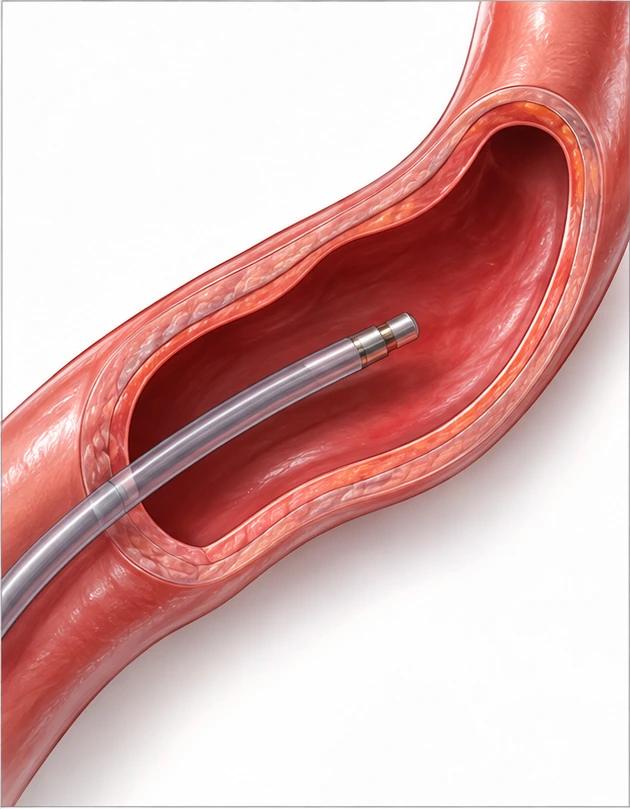
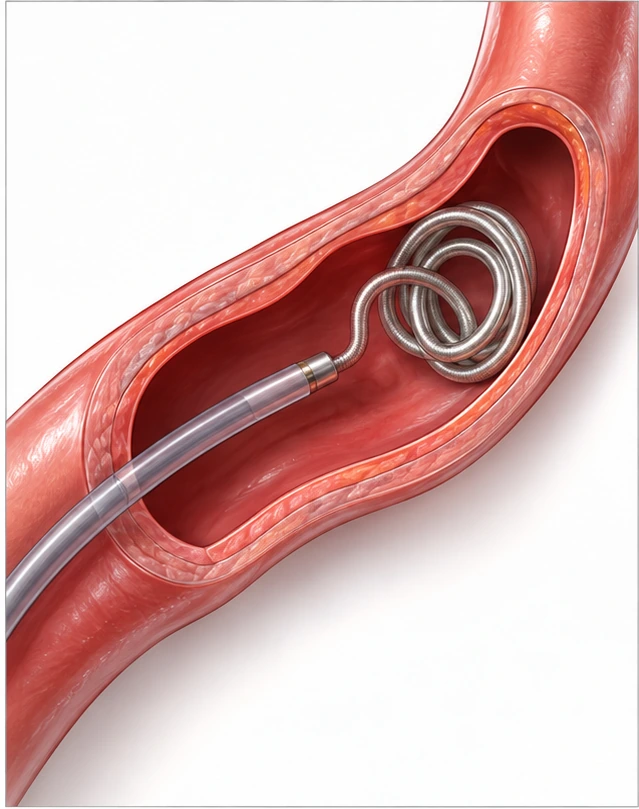
TEMMA® — Targeted Embolization for Migraine Management — is a minimally invasive procedure that reduces blood flow to the dura, the membrane surrounding the brain — a pathway strongly linked to severe migraine. A fellowship-trained neurointerventional specialist threads a microcatheter through a small puncture at the wrist or groin up to the middle meningeal artery (MMA), then deploys a tiny platinum coil to significantly reduce blood flow to the area. The procedure takes 40 minutes. Both sides are typically treated in a single session. You go home the same day — drug-free.
The dura is the pain-sensitive lining around the brain. The middle meningeal artery (MMA) supplies it. Research shows this dura–MMA system is a central driver of migraine pain — and that many migraine medications act on this exact pathway.
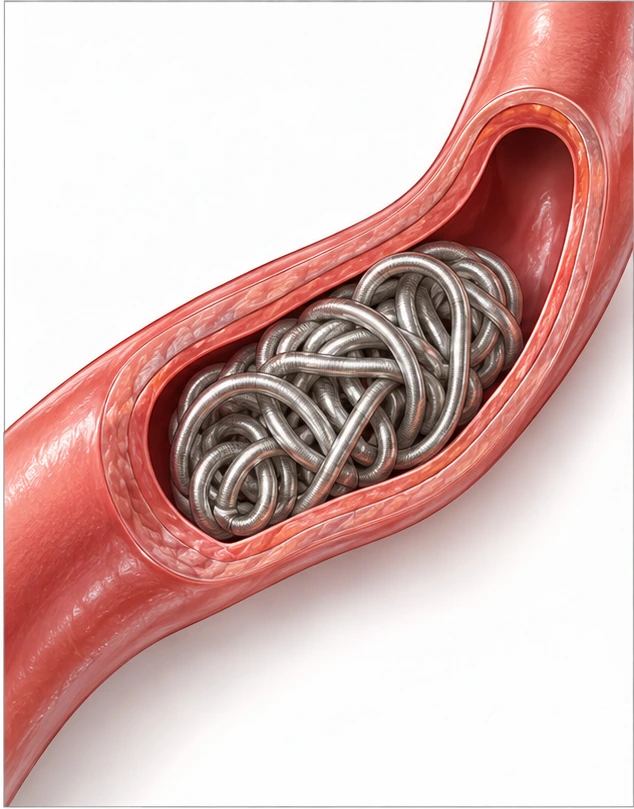
TEMMA® acts on the same pathway mechanically. By closing the MMA with a small coil, the abnormal pain signals to the dura are reduced at their source.
The procedure is performed by fellowship-trained neurointerventional specialists and typically takes 40 minutes, with patients returning home the same day. And because TEMMA® is not another medication, there are no daily pills, injections, or refills — for many patients, that means stepping off preventive medications entirely.
The TEMMA® journey is a 4-step process. The first two steps are evaluation — confirming that TEMMA® is right for you. The last two are the actual procedure and recovery.
Your journey begins with a visit to a migraine-trained neurointerventional specialist. We review your migraine history in detail — what you have tried, what has helped, what has not — along with any prior imaging (MRI or CT of the brain, if available), and discuss whether the anatomy of your middle meningeal artery and dura makes TEMMA® a reasonable option.
The lidocaine test is a short version of the TEMMA® procedure designed to predict whether it will work for you. A tiny access point is made at the wrist or groin, a thin microcatheter is guided into the middle meningeal artery using live X-ray imaging, and a small amount of lidocaine is injected. You go home the same day and track your migraine response over the next days to weeks. If your pain improves, there is a very strong chance you will benefit from the full procedure.
If the lidocaine test is positive, we move forward with the actual treatment. You receive local anesthesia at the access site and light sedation to keep you comfortable. The microcatheter is navigated up into the middle meningeal artery, where a soft platinum coil is placed to seal the artery and reduce the abnormal dural blood flow that contributes to your migraines. Both sides are typically treated in a single session.
Immediately after the procedure, you rest for 1–2 hours while the sedation wears off. A small bandage is placed at the access site, and most patients go home the same day with simple instructions. Most experience only mild soreness at the access site, temporary scalp sensations, and gradual improvement in migraine activity over the days and weeks that follow. You keep a daily headache diary, and we follow up with you over the coming months — so improvement is measured precisely, not just felt. The free TEMMA® Companion app guides this whole follow-up on your phone.
The same minimally invasive technique trusted for decades in neurointerventional medicine — applied to the migraine pathway.
Most patients return to normal activity quickly. Here's what to expect.
The technique behind TEMMA® — middle meningeal artery (MMA) embolization — has been performed thousands of times worldwide for other conditions. Across published studies for migraine, zero serious complications have been reported, and early studies show a strong safety profile with no major neurologic complications in published case series.
The diagnostic angiogram and lidocaine test are typically covered by insurance. The embolization procedure for migraine is not yet universally covered — though coverage is expanding as evidence grows.
We help you understand costs and navigate coverage options before any procedure. Our team works with you on prior authorization and can provide the clinical documentation your insurer needs. Learn more about cost and coverage →